
Mutuus Studio | Mutuus Made | www.mutuus-studio.com
Mutuus Studio’s name translates to mean a “mutual exchange.” Why is design inherently collaborative and mutually beneficial?
“Mutuus” is a Latin word meaning “mutual, reciprocal, or shared.” It implies an exchange—something given and something received—often grounded in trust, collaboration, and balance. The name embodies a philosophy of collaborative creation. Great design doesn’t happen in isolation, but through a shared process between architect and client, builder and craftsperson. Naming the studio to honor this mutual exchange reflects our approach and values.
Your firm offers architectural and interior design services as well as the fabrication of custom lighting, hardware and other specialty finishes. Tell us about this interplay.
We view a custom home as a singular, large-scale crafted object—just as vital and intentional as the hand-crafted pieces within it. We are passionate about how the interplay of scales ensures every element works in harmony to reflect our clients’ unique stories and see design as holistic, and find guiding a project from idea to realization is second nature. The more hands-on we are, the more fully we can help bring it to its best form.
What is the benefit of having so many resources under one roof?
Having a range of resources and disciplines under one roof allows us to problem-solve holistically, drawing on diverse expertise to streamline the process and assure nothing gets lost in translation. We can guide clients from design to move-in, show progress firsthand, and quickly make samples or prototypes. It enables seamless integration of our architecture, interiors, lighting, hardware, and finishes—ensuring clarity, collaboration, and a cohesive experience that brings lasting value to our clients.
You create spaces out of a multitude of materials, which elements do you find work best for your designs?
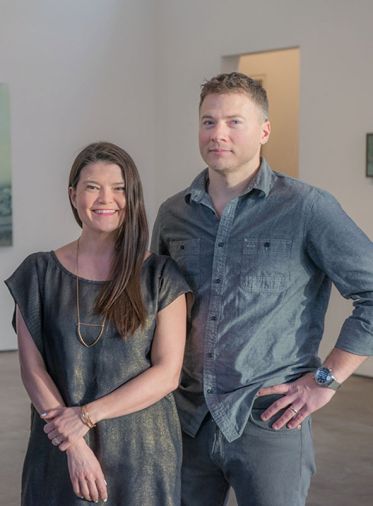
Kristen: Both Saul and I are obsessed with authentic building materials that show the evidence of the hands that made it. Honest materials that stand the test of time are what draws our attention.
Saul: I love exploring materials in new ways—laminating fabric over wood, wrapping handrails in leather, or using industrial products delicately and unexpectedly. Pushing material possibilities and embedding narrative into environments is what excites me.
You run a successful business, an in-house exhibit and event space that connects to the community and maintain an active studio practice. How has this influenced your design?
Kristen: We believe a healthy built environment begins with community. By limiting remote work, our human-centered studio and exhibit space foster connection and exposes our staff to new ideas, fueling our multidisciplinary practice.
Saul: Everything is a learning opportunity. I try to follow what excites and inspires me, without rigid definitions or expectations. Each project, event, or object builds on the last, and sharing that perspective is one of the joys of a creative life.
You are well-versed with large-scale public art installations, how has this work impacted your thinking?
Working on large-scale public art installations has deeply shaped how we think about space, context, and audience. Public art exposes you to every kind of response, often raw and unfiltered. It’s taught us to design with scale, movement, and interaction in mind—not just how something looks, but how people feel as they experience it.
How would you describe your design style?
Kristen: Our style embraces warm modernism, incorporates neutral tones, natural materials, and celebrates patinas to create spaces that feel warm, welcoming, and possess soulful energy.
Saul: Pacific Northwest modern industrial wabi sabi.
What has your deep connection to the arts brought to your work?
Kristen: With my background in dance, theatre, art, and film, I approach design through an interdisciplinary lens rooted in the arts—designing environments with the flow and intent of choreography.
Saul: I’m lucky to live by my wits, making things no one asked for. The arts gave me that stubborn motivation—and the faith that somewhere, someone might be moved. Just as artists of the past shaped me, I hope my work can offer others the same.