









In January of 2024, Jessica Shevde was on vacation with her family when an ice storm hit Portland. Shevde reached out to a neighbor to ask if they could run the water in her SW Hills home so the pipes wouldn’t freeze. “The neighbor was like, ‘You have bigger problems than that,’” says Shevde.
Several mature Douglas fir trees had fallen on the property, and one on the house, destroying a breakfast room and landscaping, and damaging the roof, windows, and surrounding deck. The kitchen had also suffered structural damage, and there were cracked ceilings in many rooms. “When we came back from our trip, there was no returning to the house,” says Shevde. While she and her husband had been doing small updates since they bought the home in 2017, they were now confronted with an entirely different prospect. “This wasn’t going to be a series of small projects like we had done before,” says Shevde. “This was going to be a big project.”
But first, the interior designer and founder of Jessica Lane Interiors needed a contractor, and quickly. “My first call was to Brian of Brian Stevenson Construction,” says Shevde. “We had worked together before and I knew he had the skilled subcontractors to do the level of detail that I wanted. It was a relief to get him on board.” Stevenson was happy to jump on the project. “Jessica is detail oriented and super organized, probably more organized than the majority of the design people I’ve worked with over my 35-plus-year career,” says Stevenson. “As well as having a great sense of design, she’s a good communicator and solution oriented.”
Once the structural updates were addressed, including a new roof, windows, plumbing, and shoring up those cracked ceilings, Shevde turned her attention to redesigning the damaged rooms. “The big question was, how do we want this house to feel? Because to me, it is an old house and we liked that about it, but we also wanted it to be young and fresh,” says Shevde. The rebuild process offered an opportunity to improve on the existing spaces, whether that was warming up the breakfast room, tweaking the kitchen layout, or opening up a wall between it and the dining room for better flow. “We had lived in the house for several years, so we knew the parts that just didn’t function,” says Shevde.
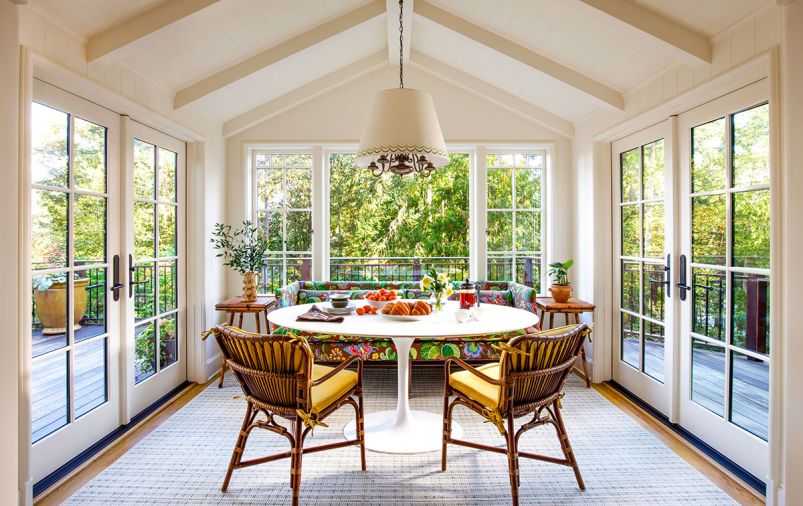
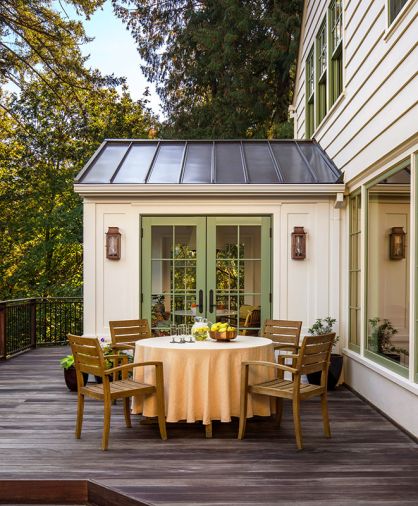
To start, the breakfast room was taken down to the foundation and rebuilt with symmetry in mind. Shevde gave it key design details to sync with the house’s 1940s traditional roots, while Stevenson shored up the supports. Now, two sets of French doors sit opposite one another, with an additional large window at the back wall, to bring in plenty of air and natural light. On the exterior, Shevde added custom molding to flank the doors, and a standing seam metal roof.
Inside, she covered walls and ceiling with V-groove paneling, clad a structural beam, and tucked in a custom sofa in a bright print behind a Saarinen-style table. “Before, it had been a cold and not very inspiring space,” says Shevde; whereas now, thanks to the natural light and cozy factor, the family hangs out there most days. “Now it’s where we eat most of our meals. The kids play Legos, and it’s where I read.”
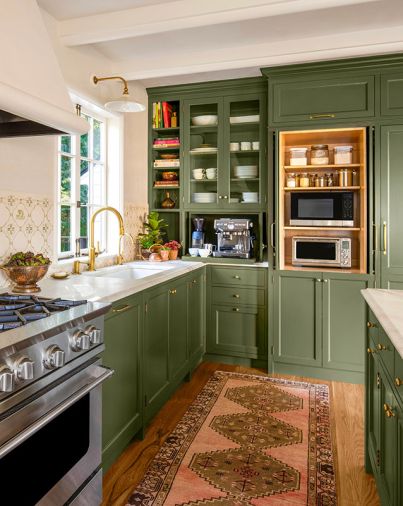
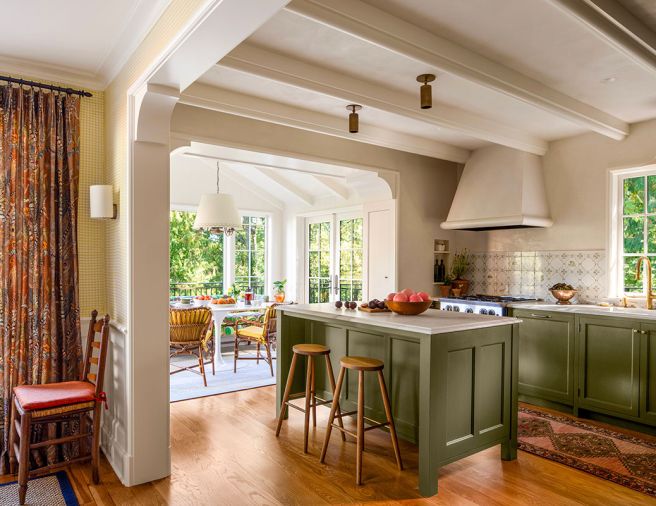
In the adjacent kitchen, the previous aesthetic veered early-2000s, sticking out like a “sore thumb” amidst the home’s traditional bones. Shevde rectified that by removing the wall between it and the dining room, and adding a cased opening for visibility and natural light. A small, cantilevered addition provided an extra fifteen square feet. “It really wasn’t a big expansion, but it was all that was needed to square up the kitchen, so it didn’t have angled walls with jogs,” says Shevde, who was then able to insert an L-shaped layout with a sizable island, and more practical storage and counter space.
“I wanted the kitchen to feel like it had always been there,” says Shevde. “I didn’t want it to look obviously new.” To that end, the palette pairs custom cabinetry in a soft green, with lacquered brass, plaster stove hood and walls, marble counters, and tailored woodwork. “Jessica really came up with some beautiful millwork,” says Stevenson. “Most of the moldings were custom milled to match the existing moldings in the house, or to match what she envisioned,” including things like the corbels in the arches, dining room wainscot, and a scalloped detail on the faux ceiling beams.
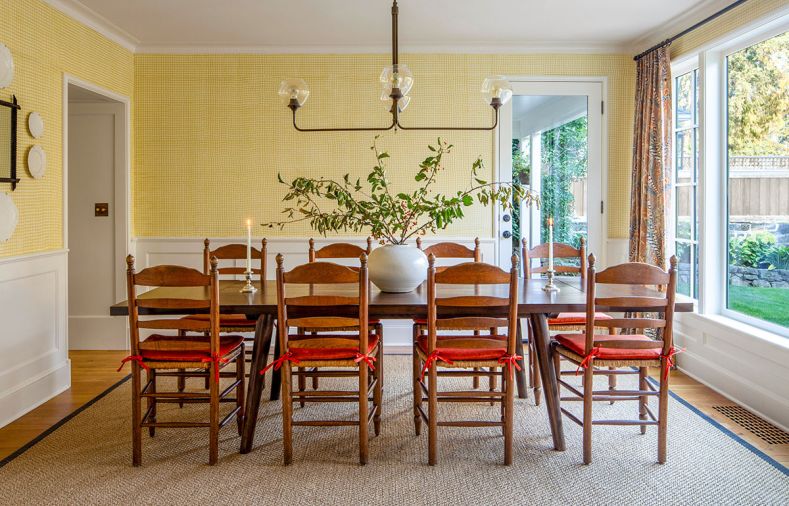
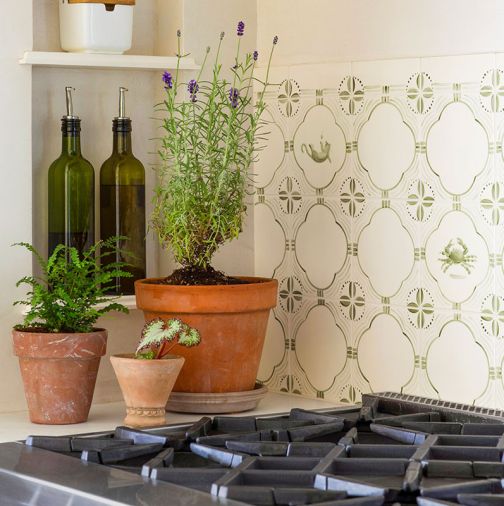
Bespoke touches make it feel personal. First, there’s the kitchen backsplash tile, which is a modern take on traditional Delft tile, produced by local artisans. On it, hand-painted animals represent the family’s shared history, such as a crab from Shevde’s home state of Maryland. In the dining room, decorative painter Robert McAnulty added a custom crosshatch pattern that contrasts nicely with the curtains that were passed down to Shevde from her grandparents. The dining room table, which sustained damage from a firefighter’s ax as they stood on it to rip down the ceiling during a building fire, was brought from New York and refinished.
Despite having to start the project in crisis, these days the home “brings us a lot of joy, and it’s definitely a happy home,” says Shevde. “It’s really the only house that we’ve lived in as a family. It’s nice to see how it’s grown with us.”
PROJECT SOURCES
INTERIOR DESIGN
Jessica Lane Interiors
jessicalaneinteriors.com
CONTRACTOR
Brian Stevenson Construction, LLC
APPLIANCES
Eastbank Contractor Appliances
eastbankappliance.com
WINDOW COVERINGS
Cindy’s Window Fashions
cindyswindowfashions.com
WINDOWS & DOORS
Portland Millwork Inc.
portlandmillwork.com
Shoptalk - Jessica Lane Shevde
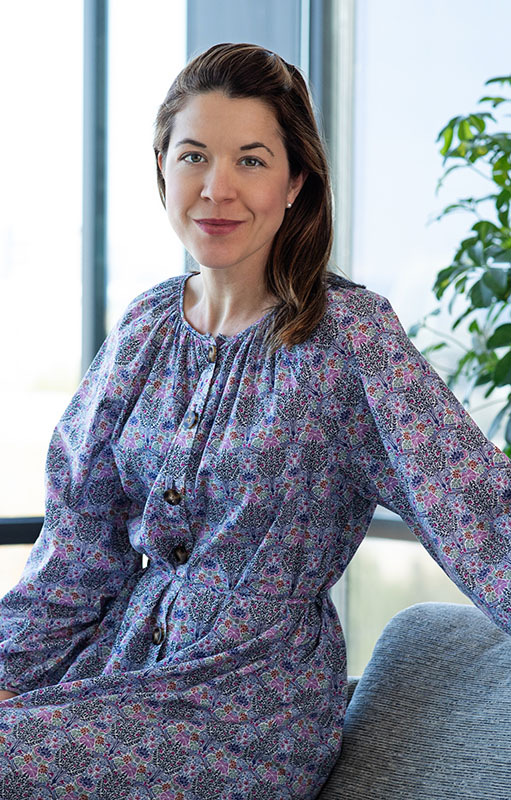
Jessica Lane Shevde, principal Jessica Lane Interiors | www.jessicalaneinteriors.com
When did you realize you wanted to pursue design?
I found my way to design by realizing what I didn’t want to do. I was on a straightforward, corporate path, and choosing a graduate program in design felt like a left turn. When I told my mom, she wasn’t surprised, she reminded me I was the kid who loved organizing her messy closets and tearing pages from shelter magazines. The connection had been there all along.
How did your East Coast experiences influence your style and design principles?
Growing up, I was surrounded by a rich mix of influences—from Colonial to European—which drew me to homes where pieces from different periods live harmoniously alongside modern furniture. I’ve always had a soft spot for classic architectural details, traditional millwork, and even formal layouts, but working in NYC taught me that great design is always specific to the location and client, so I don’t stick to just one style.
What is your approach to design and how do you imbue this in your work?
My approach starts with asking the right questions to understand client personalities and preferences, as well as to research the site’s history. From there, I develop a design concept that guides both major decisions and smaller details. With so many great options, a clear concept gives confidence to clients, reasoning behind every choice, and builds a foundation of trust.
You are known for guiding your clients through each step of the process; what is your approach?
I make my process transparent from the start, as clients should know what to expect and enjoy the journey. My presentations are never one-way; I look for what excites clients because that enthusiasm inspires me and becomes the foundation for the design. While I’m always looking to move projects forward, the process is iterative: educating, listening, gathering feedback, and refining until it feels just right.
What inspired your focus on older homes?
When I moved to Portland 10 years ago, new construction was limited, and there was growing interest in buying older homes and updating them. It felt like a natural fit, I’ve always been drawn to the puzzles that older homes offer; idiosyncrasies to embrace or resolve, discoveries along the way, and the many past lives that make up their story.
You have a reputation for sourcing and incorporating vintage pieces, why is this important to you?
Vintage items and antiques add depth and create a playful tension with newer pieces. Clients who request I source special vintage items are usually the most patient and invested as they understand that while a house can be furnished quickly, a home develops gradually, growing and evolving alongside them.
How does focusing on a limited number of projects allow for better collaboration?
Focusing on a small number of well-suited projects lets me give more personalized attention. I’m hands-on from start to finish, dedicating time to both clients and the build team. Meetings are an open dialogue—listening, giving feedback, making adjustments—so the process feels like a true partnership. My goal is always for the client to feel heard and be involved every step of the way.
You’ve worked on a variety of homes, how do you navigate the myriad of challenges?
I think of myself as the conductor of an orchestra, bringing together talented specialists, but not really being a specialist myself. I lean heavily on the project team, working with skilled contractors and talented workrooms. With every project, there is something new to learn, and that keeps me motivated.
Favorite way to spend a weekend in the Northwest?
Weekends are family time. I love getting outdoors with my sports-driven sons, and enjoying Portland’s food scene with my husband.