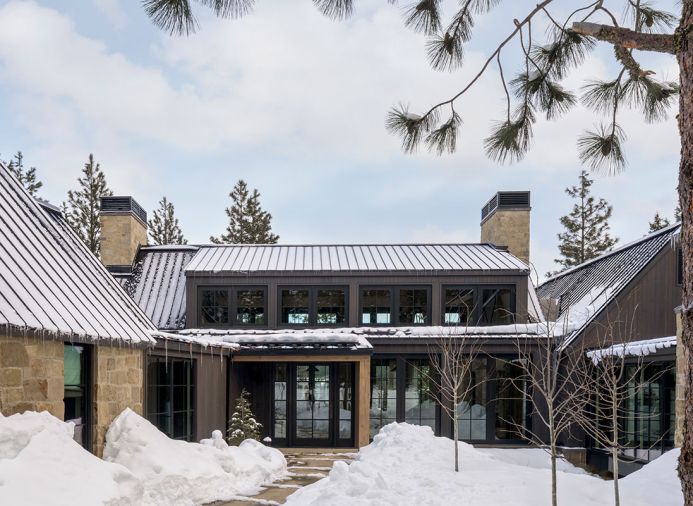
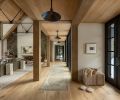

From the outside, this Tumble Creek home looks a little different from its neighbors. For starters, it doesn’t have a traditional grassy front yard. Instead, it takes on a U-shape, with three wings that wrap a courtyard dotted with several mature trees. Head up the path to the front door, and there’s a glass hallway bridge to the right, suspended over a dry creek bed. It’s a moment of pause built into the architecture.
While the back of the house has extra-tall window walls to capture the views of the Eastern Washington valley beyond, it’s part of the ethos of the entire home’s design that such quiet details at the front were equally considered. “The front of the house was just as important as the back of the house,” says architect Jim Romano of Conard Romano Architects. “The drama is on the back side, but the whole entry sequence makes it so that you are enveloped by the house. It has a different, more intimate feel to it.”
Romano teamed up with Kat Lawton Interiors and contractor Artisan Inc. to craft this compelling abode in Tumble Creek, a private mountain community in Cle Elum. It’s for a family of six that are usually based near Seattle, but loved the idea of a retreat where they could spend time together with family and friends any time of year. When Romano first visited the lot, he noticed the striking views at the back, of course, but he also thought about what he wasn’t seeing yet. “Our goal was to take advantage of the site and the views, and preserve as many trees as possible,” says Romano. “But we also had to plan knowing that the adjacent properties would get built on.”
Thus, the U-shape of the house was formed, which maximized the already awkward, pie-shaped lot. By pushing the back of the house toward the bluffs, Romano was able to maximize the views there, while the wings and front courtyard foster privacy, protect sightlines from neighbors, and connect to nature on both sides. “This created an inner court that allowed for privacy to the interior of the house, as well as transparency to the exterior,” says Romano. “I think it helps to anchor the building.”
The central section, or social hub, has the great room, with separate wings for the garage and media rooms on one side, and a series of guest suites on the other, the latter accessed by the glass bridge. “The house is really conceived as a series of buildings, each with a fairly distinct function,” says Romano. “The guest quarters are literally and figuratively removed from the main house by the bridge.” That way, when the owners are there on their own, they can close that wing off. When guests are with them, it’s a comfortable area well away from public spaces that feels like their own.
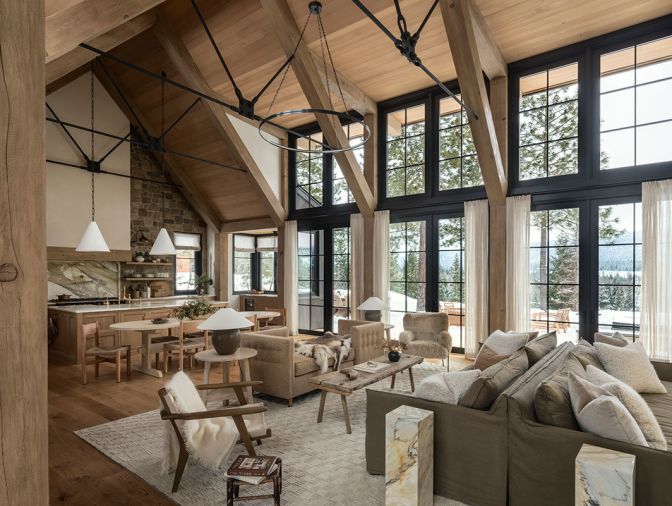
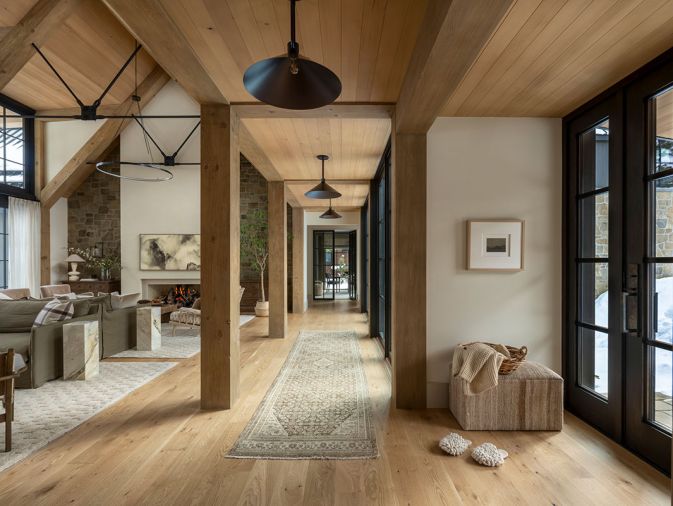
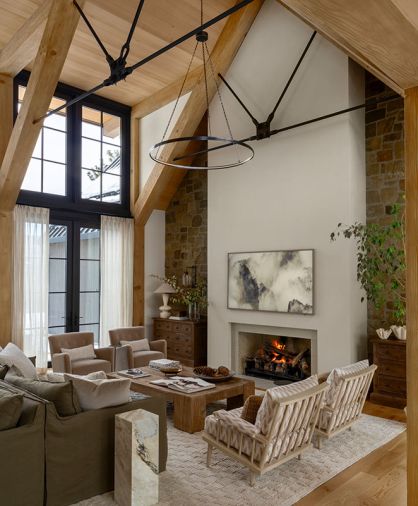
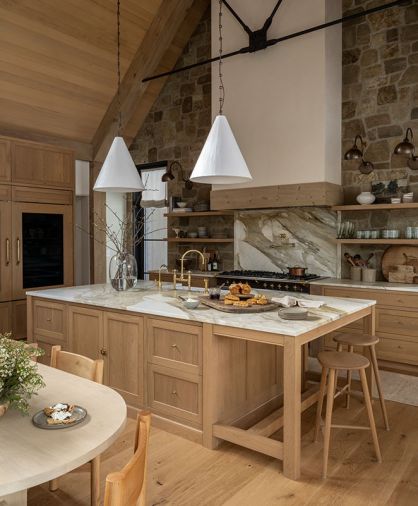
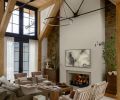
The great room contains the kitchen, dining room, and living room, and can comfortably host anywhere from six to forty people, such as when the owners have big gatherings like their annual Labor Day weekend pickleball tournament. The soaring interior volume is outlined by a timber framework, with metal spans that crisscross the expanse, and glass inserted between the timber trusses. “It’s a layering of elements that really makes the scale approachable,” says Romano. Tumbled stone walls on either end of the room feature large-scale stones to a useful effect. “It’s a little counterintuitive, but the bigger that stone is, the more it helps bring the scale of the house down,” says Romano.
Working with Lawton, the pair established an overall palette that was “refined and curated,” rather than too rustic. “Kat instills such confidence and trust,” says Romano. “She puts together such wonderful textures and compositions. It’s a real art.” For Lawton’s part, the aim was to put a Pacific Northwest spin on Belgian-style interiors. “One of the concepts that I was playing with on the front end was ‘traditionally rooted, but minimally executed,’” says Lawton, which meant leaning into traditional shapes with simplified detailing, and weaving in luxe basics, and natural materials. Throughout, the designer appreciated the collaboration with Romano in the process. “He is so approachable,” says Lawton. “I can come to him with ideas and he’ll lean into it. He’s very collaborative and knowledgeable.”
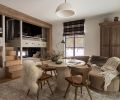
Starting with the great room, Lawton zoned the open floorplan with deft furniture groupings. A double-back sofa is the “axis point,” she says, with one side “cocooning” the fireplace and television, and the other facing its own conversation area. There, a mix of seating options are on offer, including a “tete-a-tete” tufted daybed that the designer knew was a family favorite, having worked with them on their Seattle home over ten years ago. “All of the kids fight over it, it’s a well-cherished piece,” says Lawton. Being open on both sides, it then connects the conversation area fluidly to the dining room and kitchen.
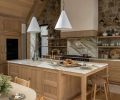
In the latter, the materials shine, with a Calacatta Gold marble backsplash set against the stone wall. “I wanted to create a juxtaposition between the refined polish of the Calacatta Gold slab, and the rough and tumble stone veneer,” says Lawton. “I just think that hybrid is really interesting to the eye.” That elevation is then underscored by the medley of woods, including white oak floors and cabinets, Douglas fir beams and hemlock ceilings, with everything skillfully treated to ensure the wood tones synched up. “The general contractor had such an excellent team,” says Lawton. “They were really truly artists, and insanely talented. Plus, they are so on top of the schedule, budget, and communicating to the client. They can do it all.”
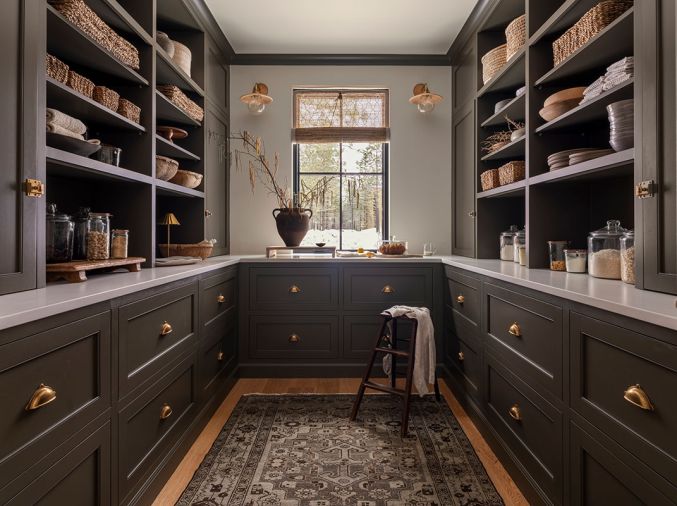
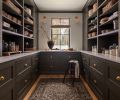
The kitchen is then complemented by the pantry, whose good looks belie how hard it works. “It’s a workhorse,” confirms Lawton. Everything from mini appliances to food storage is tucked behind the custom cabinetry or arrayed on open shelves. The olive shade of the cabinetry is a counterpoint to the caramels and cream color palette in the main room, while the bunk rooms down the hall take their cues from the seasons.
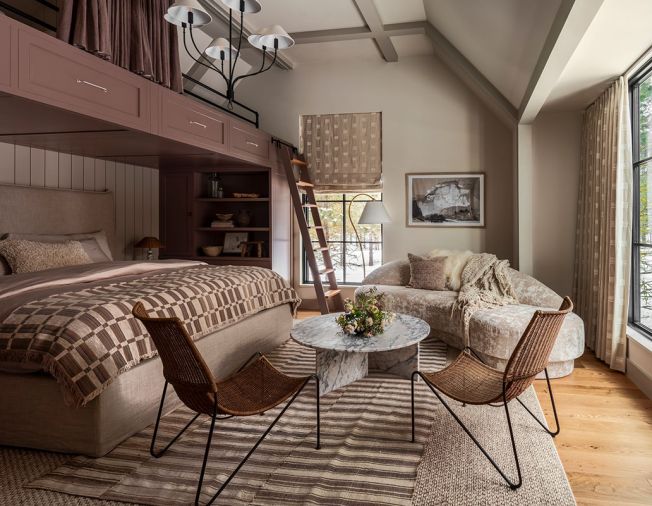
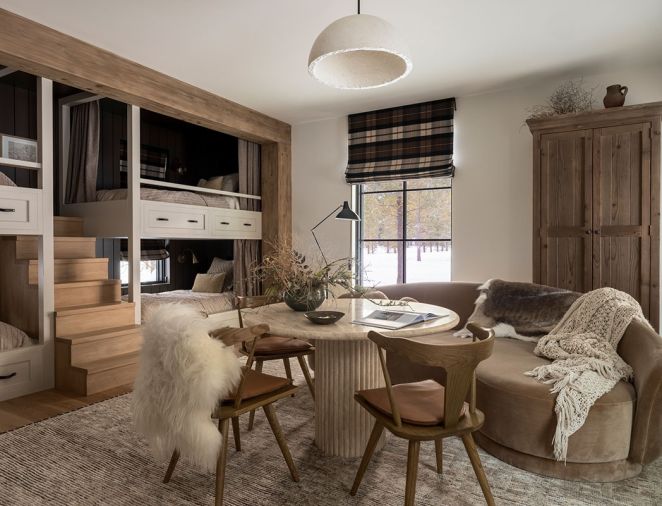
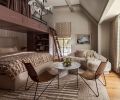
In the “Summer Room,” that means lighter weight linens and mauve and chocolate hues, while the “Fall Room” has a subtle herringbone on the train curtains, and Ralph Lauren tartan. The layouts maximize guest comfort, so kids can bunk together, or in the case of the “Summer Room,” parents can occupy the king bed below, while their children sleep overhead. The rooms maximize the high ceilings for extra sleeping quarters to accommodate the couple’s four children and future grandchildren. A tidy amount of open floor space allows for a comfortable lounge area in both rooms, with the “Fall Room” even having a table suitably sized for the son’s poker tournaments.
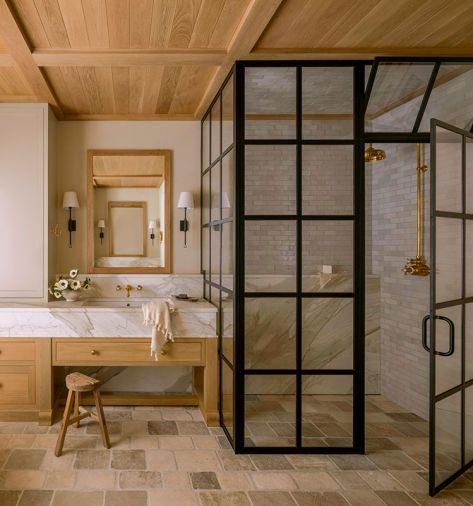
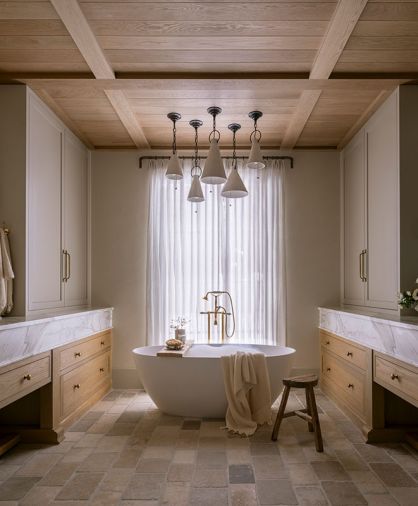
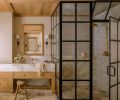
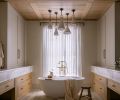
In contrast with the sociability of so many other spots in the home, the hosts’ primary suite is a true retreat. This starts with the tumbled antique limestone paver floor, which has pieces that vary in size and thickness. “It has a cobbled quality to it, as I really wanted that to just steal the show,” says Lawton. She then layered in quieter bespoke elements, like the vanities with their trestle base and thick marble fronts, and the artisan-made pendants suspended over the concrete tub. Even the wax-finished white oak ceiling provides a natural glow.
Such is how the entire team’s eye for craft and attention to detail underscores every nook and cranny. Just take another look at that bathroom ceiling. “We installed the rift white oak so you can’t see a single fastener,” says contractor Josh Sevigny of Artisan Inc. “It’s a simple thing most people are not going to notice, but we’re really proud of how that turned out. It’s all in the details with this house.”
PROJECT SOURCES
ARCHITECT
Conard Romano Architects
conardromano.com
INTERIOR DESIGN
Kat Lawton Interiors
katlawton.com
CONTRACTOR
Artisan Inc.
artisaninc.net
SELECT FURNISHINGS
J Garner Home
jgarnerhome.com
WOOD FLOORING
Montello Design
montellodesign.co
Shoptalk - Jim Romano

Jim Romano, principal Conard Romano Architects | www.conardromano.com
What types of projects do you take on?
We work with clients that are seeking to create something unique and specific to them and who understand how good design can improve their lives. For us, the scale of the project is not as important as the intent of the project, thus we enjoy designing at all scales of architecture from small interior remodels to large new homes.
Has there been a defining experience that has significantly influenced your viewpoint on design?
Growing up in the Pacific Northwest, I can’t help but be influenced by our climate and natural setting. The range of outdoor experiences, from forested mountains to the ocean shore, inherently influences how we approach design and the architecture we are creating.
You are known for stellar design and technical expertise. What should be considered when creating a custom home?
Careful planning is required, starting with analysis of the site and program, and assembling a strong and experienced team. Open communication within the team allows for the collaboration necessary for an alignment of expectations. And understanding the expectations allows for the planning by the team that is necessary to navigate the countless decisions required in creating a custom home.
Where do you start with your clients?
Our process begins with listening, which continues throughout the project. We don’t put pencil to paper until we have a clear understanding of not only our client’s goals for the project but also the intangibles of how they live now and how we can enhance that through design.
Clients appreciate your ability to offer a balance of innovation and tradition, what does that look like for your team?
We work to ensure that historic principles of scale, proportion, and hierarchy are understood and underpin our designs. Those principles are the guardrails that help create architecture that is authentic, whether the architectural style is traditional or more contemporary.
You prioritize innovative choices about materials, sustainability, and building systems. Are there ideas you think should be front and center in the minds of residential architects?
As architects, we should always work toward using materials and systems that not only minimize impacts on the environment but can work toward enhancing the environment. Understanding the ever-evolving range of sustainable building materials, energy efficient systems and assemblies, and healthier building products allow us to better inform our clients and their choices.
You’ve worked on a variety of residential spaces, what speaks to you about these projects?
I appreciate how unique each project is. We have had the opportunity to work with a wonderful range of clients, each with their own specific vision. I am proud that the design solutions, and thus our body of work, are a creative reflection of our clients without us imposing a firm-identifiable signature style.
What part of the design process do you find most rewarding?
It is the personal relationship with our clients; getting to know them allows us to create designs unique to them.
How do your interests outside of work keep you motivated?
Adventures in the mountains and on the water keep me grounded and inspired.