
Homeowner Emily Christensen could see the vision when she first stepped into her 1914 Mount Baker Craftsman. Period details—transoms, stained glass, and richly stained millwork—gave the house a warmth and heritage that immediately resonated with the family of five. The kitchen, however, told a different story. Largely untouched since the 1950s, it was overdue for a renovation that could better support modern family life.
For some prospective buyers, living amid construction would be a drawback, but they were eager to make it their own. Over a six-month period, the Christensen family worked with contractor Ross Smith of Bevel, who referred them to Emily Johnston of 92 Maple Design to take on the kitchen and adjacent powder bathroom, all while maintaining the artisanal spirit that first drew them in.
“We were lucky the previous owners had just touched the kitchen and left everything else,” says Johnston. Even so, the existing layout presented several challenges: a low ceiling with fluorescent panels and a configuration that closed the kitchen off from the adjoining dining room.
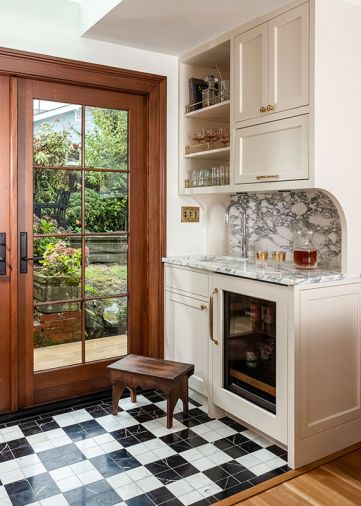
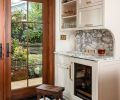
Over the years, the back of the house had also gained a series of awkward additions. “What is now the tiled bar area and the little powder room were part of a strange addition,” recalls Smith. “The powder room had a unique L-shaped layout that was difficult to work around.” To keep the renovation manageable, they chose to largely work within the existing footprint.
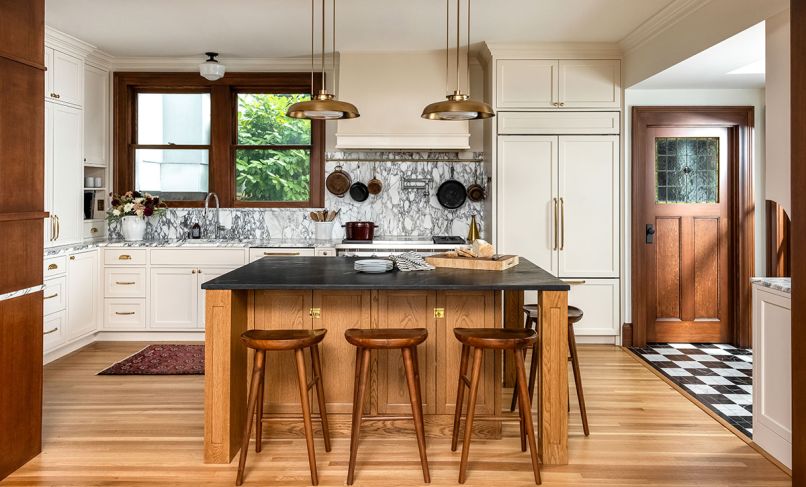
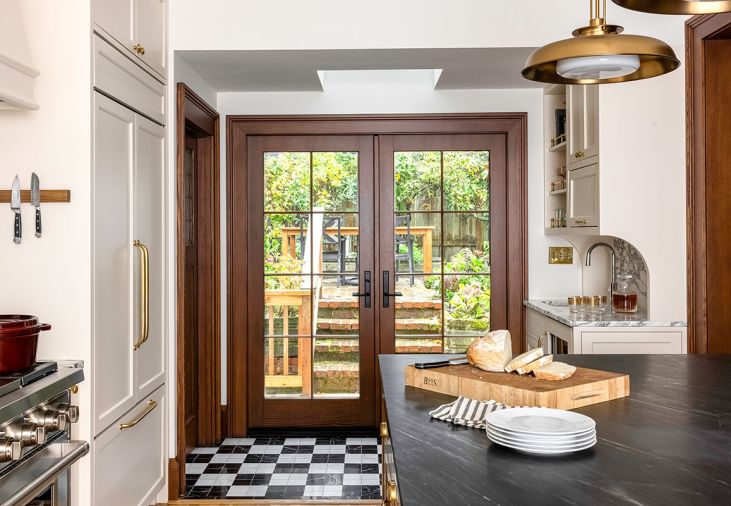
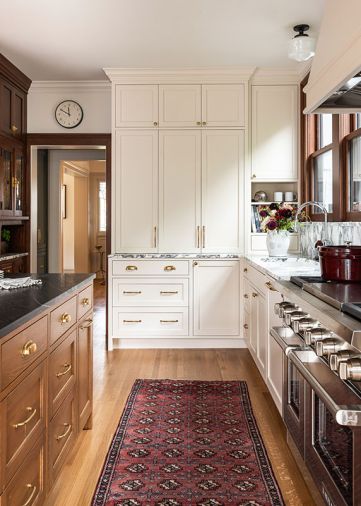
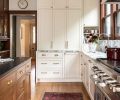
Removing the wall between the kitchen and dining room became the project’s defining move and the start of what Johnston calls “design Tetris.” The team needed to fit a custom central island and oversized appliances, including a paneled 48-inch range and 42-inch refrigerator, without sacrificing circulation.
But opening the space came with tradeoffs. “People love islands, and they’re fantastic,” Johnston says. “But when you remove a wall, you lose an entire run of storage. For a family of five that was a big deal.”
The solution was a “workhorse” of an island with deeper storage than its modest six-foot length might suggest, notes the designer. Custom-built from white oak in Bevel’s cabinetry shop, the piece is packed with hidden pullouts. “We used 27-inch drawer hardware when the standard is about 21 inches,” Smith says. “You pull the drawer out and it just keeps going.” Narrow spice pullouts flank the range, while additional cabinetry helps compensate for the storage lost when the dividing wall came down.
Equally important was ensuring the new kitchen felt cohesive with the rest of the century-old home, which includes beams and fir trim. “When people come over, they can’t tell what’s original and what’s new,” says Christensen. Cabinetry in a warm white hue was paired with marble countertops and a soapstone island that was “more beautiful than anticipated with hints of green,” she adds. While she had initially considered going for all green cabinets, a bank of pantry cabinets in the cheerful shade infuses a pop of color.
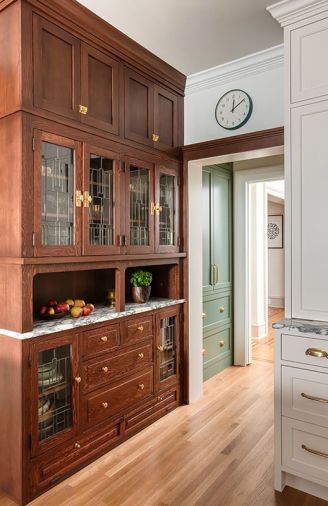
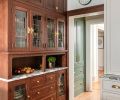
Preserving original elements also played a central role in the renovation. When the wall between the dining room and kitchen was removed, the home’s original built-in hutch had to be carefully salvaged. The piece was refinished and raised 18 inches, so its proportions aligned with the new kitchen ceiling height. A stained-glass-topped door that once connected the dining room and kitchen was relocated and reused as the powder room door.
For Christensen, the kitchen’s most meaningful features are often the ones used daily. When the couple selected their range, they opted for a double griddle—an addition that quickly became a family favorite. “We make pancakes for the kids all the time,” she says. “The other night for my son’s birthday we made dozens of cheeseburger sliders on it.”
Another indulgence is the beverage center, which features a tap that dispenses sparkling, still, and hot water. “It’s definitely a luxury,” says the homeowner.
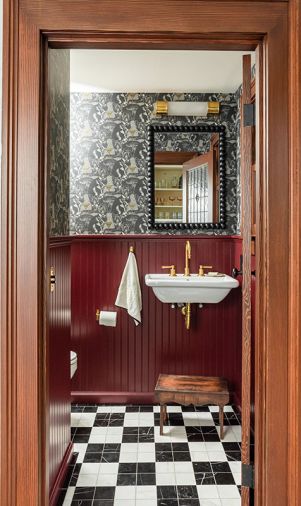
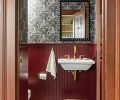
While the kitchen carries the renovation’s architectural weight, the adjacent powder room is a moment for rich hues and playful patterns. “In our previous home, we had large-format marble checkerboard floors, and I really wanted to incorporate that style into this project,” she says.
The original bathroom, which Johnston called utilitarian with its beige scheme, hollow-core door, 1980s doorknob, and offset sconce has now become a design moment with graphic wallpaper and red walls. “It felt like the perfect place to do something fun and a little moody,” says Christensen. “We have a black cat, and every Friday is pizza movie night for the kids, and martini night for me and my husband,” she says, “So when I came across this fun wallpaper, I knew it would be perfect.” Delighted the project went so smoothly, the homeowners feel rooted in place with upgrades that will support the family and future owners for another century.
PROJECT SOURCES
INTERIOR DESIGN
92 Maple Design
92maple.com
CONTRACTOR
BEVEL
bevelbuilds.com
Shoptalk - Emily Johnston

Emily Johnston, owner and principal designer 92 Maple Design | www.92maple.com
Was design something you’ve always felt strongly about?
I’ve always tended to think spatially and noticed how spaces could work better. For me, the fun is figuring out the layout, how people move through a home and use it day to day. Once that puzzle is solved, the finishes tend to come more easily.
How do you approach newer versus older homes?
Older homes feel comfortable because of their layers, details which are thoughtful, but not overworked. In newer homes, I lean on natural materials, a variety of finishes, carefully scaled millwork, and small architectural details that don’t feel forced. When those pieces are handled well, the house feels settled rather than freshly built.
Why is it important to have homeowners who appreciate the history of their home?
When homeowners genuinely appreciate the story of a house, decisions feel more intentional and collaborative. You’re not just renovating a structure; you’re continuing a story. That shared respect for a home leads to better outcomes and a more rewarding experience for everyone involved.
Tell us about the ongoing effort to maximize the quality and ease of living.
Surprisingly simple adjustments can make a tremendous difference. Opening a pathway between rooms, shifting a kitchen a few feet, or rethinking how spaces connect can completely change the feel of a home. When a layout starts working with a family instead of against them, everyday life becomes noticeably easier and the house feels far more welcoming.
With extensive experience in solving design challenges, particularly in kitchens and bathrooms, how does one respect a home’s character?
Kitchens and bathrooms usually need the most updating, but those spaces should feel connected to the rest of the house. I pay close attention to scale, materials, and the small details that tie back to the home’s era. When those elements are handled carefully, the new space feels like a natural continuation rather than a modern interruption.
What steps are taken to focus on details appropriate to a home’s architecture, so a renovation feels authentic?
Natural materials age in step with a home, which is part of what makes them so important. When wood, stone, and other honest materials are used thoughtfully, they gather character over time, instead of looking dated. The goal is to create something that feels rooted in the house rather than looking like something that was added later.
How do you manage different architectural challenges, or what you refer to as a “good design pivot”?
Renovations have a way of revealing surprises once walls come down, and sometimes the best move is to rethink the plan entirely. A design pivot forces you to look at the space from a different angle and those shifts often lead to solutions that are far more interesting than the original idea. I love a design pivot.
What is your favorite space in your own home and why?
Our dining room, oddly enough. I moved a couch in there one day, and it accidentally became everyone’s favorite place.
What do you consider crucial design elements?
A thoughtful layout, honest materials, and the restraint to let a home speak for itself.