
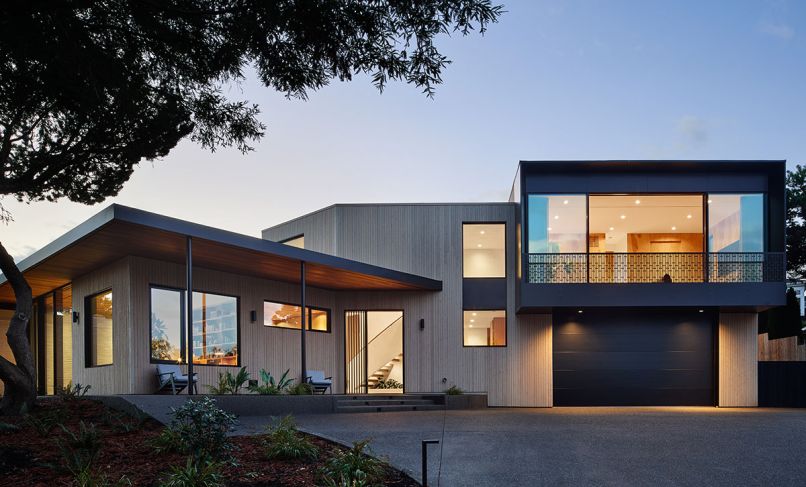
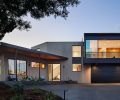


Atop Council Crest neighborhood sat a mid-century modern home built in 1959 whose original style had been badly muddled by a 1990s remodel. The couple who purchased it in 2022 had visions of restoring its original flair. After interviewing several architects, they chose Risa Boyer Architecture (RBA), since Boyer is known for her excellent remodel work on mid-century homes.
“Risa’s work really resonated with me,” says the homeowner, “and given the male dominance in the field of architecture, I was thrilled to have the opportunity to work with an all-female firm.”
“The couple had recently built a home from the ground up at Brasada Ranch and each came with design ideas, details and lessons learned,” recalls Boyer, who, in turn, recommended contractor Don Tankersley & Co. (DTC) to the couple. After interviewing two other builders, the couple chose Tankersley, who they’d met socially on occasion and whose reputation they’d known about for years. In the end, they believed he was the best choice for their project. “It was our first time working with Don,” says Boyer, “but we knew DTC’s work, and their attention to detail.”
As soon as the renovation of the original home was underway, it became clear to all, Tankersley’s team included, that given the presence of asbestos and heavy deterioration, the home was not salvageable. Although, from a sustainability position, a tear down could be an excellent opportunity to build a high-performance structure.
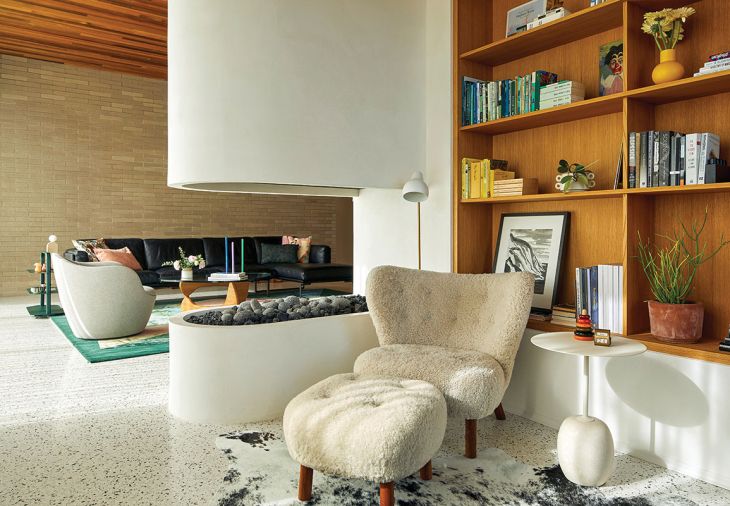
To that end, Boyer called upon her leadership in conceptual design direction to present five different plans for her clients to pick and choose from, all making use of the existing foundation. The couple’s previous home was diametrically opposed to the look of the mid-century style home they were seeking. “It was very masculine, with hard edges, right angles and white laminated wood, a feel I did not want to repeat,” says the homeowner. Her partner, who came to the table from an engineer’s perspective, was armed with intense research that focused on the mechanical elements of the design. Namely, the massive rainwater collection system, geothermal heat pump, hydronic radiant heating and cooling floors, and solar panels, to name a few. Boyer’s design weaves these high-performance systems of environmental sustainability seamlessly into the architecture, featuring stained tongue and groove cedar siding, a living green roof and striking brick feature that spans both a living room wall and an exterior façade. Lilyvilla Gardens’ landscape features drought resistant plants, eco-lawn, a flower and grass meadow, and saving 50-year-old cherry trees, sculptural shore pine, and redwood.
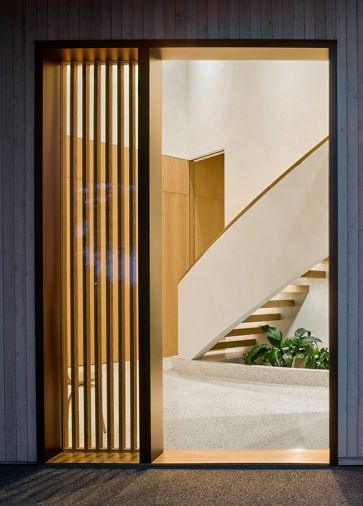
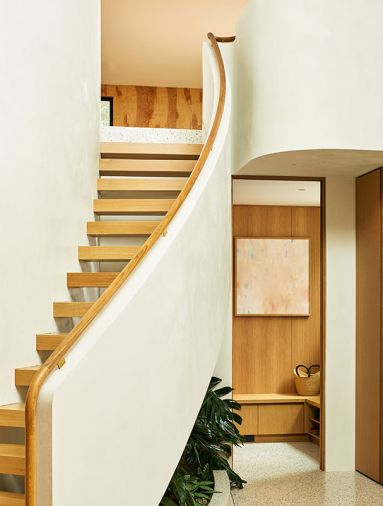
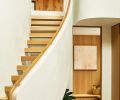
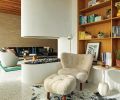
Drawing on the couple’s memories of living in Europe, Boyer’s plans included many stylish elements: from the built-in interior planters whose curved edges ground the voluptuous entry staircase, to the serene hand-troweled plaster curves found in the living room fireplace. “Because of the minimal architectural finishes and palette,” explains Boyer, “the curved shapes added softness to the house.”
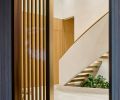
Working with Boyer was very much an open collaboration involving constant brainstorming. The homeowners say the idea of creating a curved entry staircase grew out of a series of organic, progressive discussions. Boyer embraced the sensual style and artfully finished it using pristine Venetian plaster, crowned with a lush oak handrail. Two years in, the homeowners continue to be awed by the light, texture, and intimate grandness of the entryway.
Tankersley took Boyer’s drawings and presented both her team and the homeowners with a solid construction proposal. “Having followed Risa and her team’s work for years,” recalls Tankersley, “I was delighted to find the company’s drawings well thought through and complete. Although there were challenging aspects to the job, given the high level of finishes needed to deliver the cabinetry, brick and terrazzo flooring, everything was done with such intentionality that there was never a collision.”
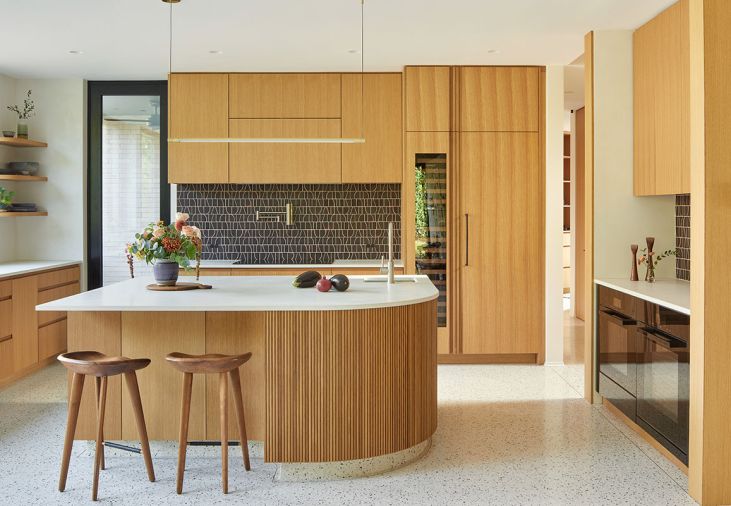
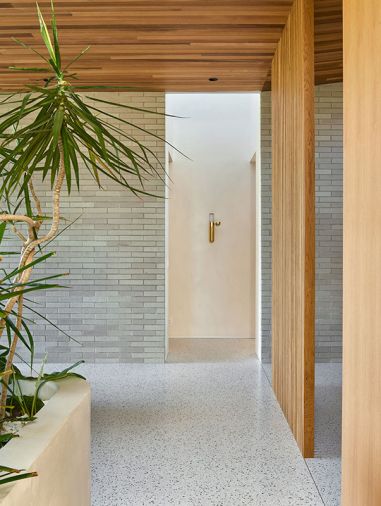
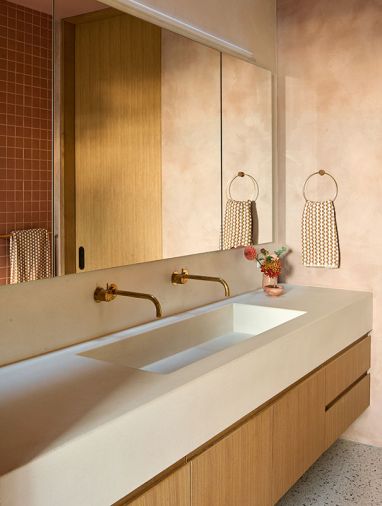
It was Boyer who suggested they float the terrazzo floors throughout the entire home, a decision that required the clients to become deeply engaged. Not only were the floors reminiscent of the client’s European upbringing, but being able to choose the stones became a highly creative task. “We were able to choose the colors for the background and the colors that pop from a near infinite variety,” says the homeowner. “I settled on amethyst, olivine, and citrine for the primary colors. We had eleven different sample tiles created before we landed on the right mix.”
“The owners,” says Tankersley, “were great patrons of the arts, who appreciated good craftsmanship and wanted things done with good taste that’s meant to last. The entry way ceiling vestibule, for example, is Venetian plaster. When you walk through, it catches the light in different ways at different times of the day.”
The couple was equally adamant about wanting the woodwork to be made from real wood, not laminate. “They wanted craftsmanship that ages gracefully,” notes Tankersley. “They didn’t want pressboard that when kids get a nick in a corner cabinet, reveals itself. The more honest the materials, the better it will age.”
Boyer agrees, stating her team had a heavy focus on warm, high quality textural materials and unique tile sourced locally. “The entry is the grandest space in the home with its high ceiling and curved staircase,” says Boyer. “As you move through the house, the rooms scale according to the function, but the refined palette and details remain consistent. In the bedroom wing, the ceiling lowers and the space is cozier.”
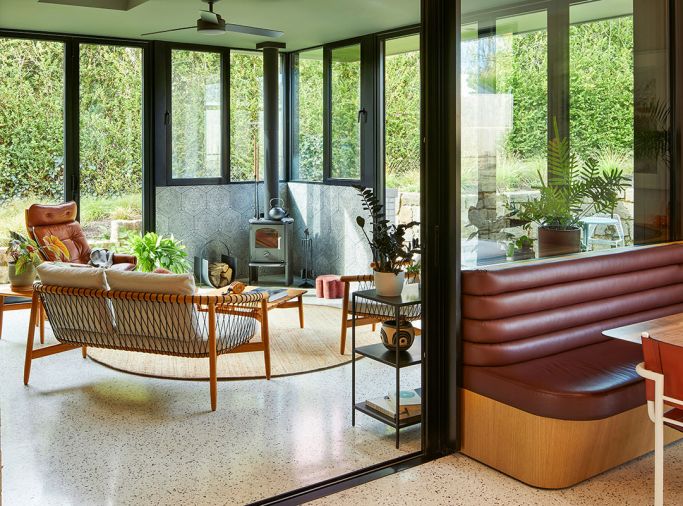
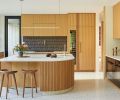
The kitchen becomes the star that embellishes the voluptuous roundness, found first on the island, where long strips of white oak with an oil finish formed into a sensuous curve. The custom counters are next, echoing the natural terrazzo flooring. The hand-formed darkly dramatic stove tile backsplash is a mix of random shapes that counter the island’s soft, roundness. In the dining area opposite, a vintage style upholstered burgundy leather banquette sits upon a handsome, rounded rift sawn white oak base.
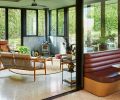
The mood changes dramatically upon stepping over a threshold of aluminum clad glass doors into what the homeowner describes as a “Lanai” or open-sided veranda. She utilized comfy outdoor seating from their previous home, adding a cast iron wood burning stove for its rustic old-world look, then backed it with hexagonal tile for its unique look.
Tankersley acknowledges how important it was that RBA brought his team onboard so early, giving them plenty of time to deliver the complex features the homeowner outlined. “It’s nice when you have a client who wants to have it built right.”
“One of the biggest joys,” add the homeowners, “was working with Don and all the talented craftsmen and woodworkers who came together to create Risa’s designs.”
PROJECT SOURCES
ARCHITECT & INTERIOR DESIGN
Risa Boyer Architecture
risaboyer.com
CONTRACTOR
Don Tankersley & Co.
dtcportland.com
LANDSCAPE DESIGN
Lilyvilla Gardens
lilyvillagardens.com
APPLIANCES
Eastbank Contractor Appliances
eastbankappliance.com
COUNTERTOPS AND SINKS
Cement Elegance
cementelegance.com
CUSTOM RAILING
MW Design Workshop
mwdesignworkshop.com
FIREPLACE
Lisac’s Fireplaces & Stoves
lisacsfireplaces.com
WINDOWS & DOORS
Portland Millwork Inc.
portlandmillwork.com
Shoptalk - Don Tankersley
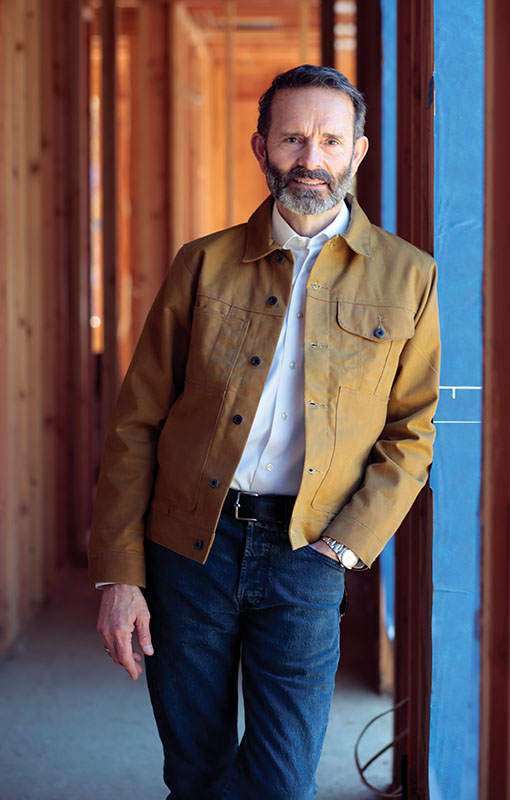
Don Tankersley, founder Don Takersley & Co. | www.dtcportland.com
What are your observations after three decades of running a construction company?
We have been fortunate to work with incredible clients, many of whom have returned for multiple projects and have introduced us to their friends, neighbors, and even their children. We take that responsibility very seriously. More than just builders, we act as trusted advisors and stewards of the resources that clients place in our care.
When does your company typically get involved within the project lifecycle?
We usually join projects early, during conceptual design with architects or during due diligence with owners. We stay involved throughout the entire project lifecycle even beyond construction completion, supporting ongoing maintenance, improvements and future remodels.
You build a variety of architectural building styles, how do you manage the inherent challenges that come with that range?
We have deeply cherished relationships with extraordinary architects, designers, trade-partners, vendors, fabricators and artisans. This is a dynamic group, including those I’ve worked with for over 30 years and those just recently met. Design is the origin of everything we build, and it takes a collaborative team of disparate experts to realize success. In addition to being technically skilled, our community is thoughtful, kind, enthusiastic and eager to contribute.
Tell us about your team, who is known for exceptional craftsmanship and rigorous project management.
While the company carries my name, it’s always been about the entire group of people supporting the work. I’m grateful to be surrounded by a dedicated team of longtime employees; across project management, coordination, carpentry, leadership, and pre-construction. At the heart of it, we bring people together; thoughtfully assembling the right team for each project and working collaboratively to see it through with care and precision.
You have a reputation for being a problem-solver, how do you approach finding solutions?
Communication is key. We stay closely connected with clients and architects throughout the process, sharing updates, coordinating meetings, and handling payment applications. It’s this combination of careful planning, hands-on management, and open collaboration that allows us to guide each project smoothly from concept to completion.
What are the unifying themes and principles of the projects you build?
We build thoughtfully designed homes, along with select hospitality, cultural, and institutional projects. What matters most to me is building something enduring; homes that feel grounded in their place, quietly beautiful, and made to last. If a project can be lived in, deeply, and still feel relevant and respected for generations, that’s the kind of work of which we aspire to be part.
What encouraged your passion for construction?
I grew up on my parents’ berry farm in Oregon’s Tualatin River Valley, where I learned the value of hard work, responsibility and an appreciation for beauty. Building was simply part of life. My parents even built our family home while I was in grade school.
Where do you go to unwind from your busy schedule?
I find peace outdoors. Hiking the trails of the Columbia Gorge, tending the garden, and enjoying the changing seasons. Those quiet, grounded moments help me step back, recharge, and remember what really matters.