
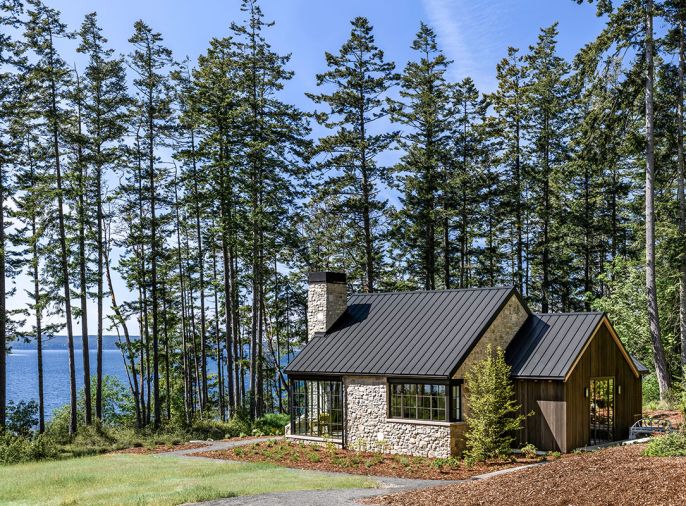

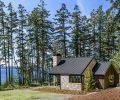
The road to Jennifer Muller’s cottage outside of Port Townsend, Washington winds through the dense Pacific Northwest woods, before emerging into an open meadow on a bluff above Discovery Bay. Tucked along the edge of the grass against the tree line, the profile of the home’s gabled roof and stone chimney looks, for a moment, as though it came from the pages of a children’s fable. For Jennifer, who grew up in Seattle and spent her summers in a cabin in the San Juan Islands, evoking that familiar comfort was what started the project. “I wanted to have a place long-term, where I could go back to my roots,” says Jennifer.
She spontaneously found the twenty-acre property in 2020. “I didn’t know Port Townsend all that well, but there was good coffee and a bakery,” she says. “I thought, ‘If I can have a town with good coffee and baked goods, and a wonderful piece of property, I’m not sure what else I need.’” Her search for a design and construction team was equally fortuitous, when she noticed that so many of her favorite inspiration images had the same key players: DeForest Architects, contractor Lockhart Suver, and NB Design Group.
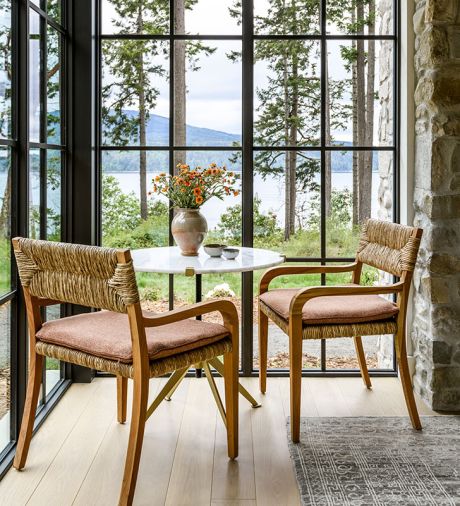
After spending some time camping on the property and getting to know the lay of the land, Jennifer told her team what she wanted for a house there: “It was important to emphasize the view, but I also wanted something that felt very protected,” she says. To accomplish that, they placed the 1500-square-foot cottage along the meadow’s edge to capture sightlines to the bay and mountains as they filter through the trees. As for materials, stone was the first choice. “The stone of the project really came out of that goal to be protected and sheltered,” says architect Brett Smith of DeForest Architects. “It was about balancing those two things: the grounded aspects of the home, and the open connection with the outside and the bay.”
Now that balance is seen on the exterior facade, with the juxtaposition of salvaged stone from a deconstructed hamlet in Italy, crisp black aluminum windows and doors, and the sharp line of the standing seam metal roof. “One of the most important design aspects of the home is the stone, so it took a lot of time and effort to really get it right,” says Josh Ferrel of the construction firm Lockhart Suver. The team took weeks of careful placement and editing to achieve the look. “It was an evolving process,” says Ferrel. “We would put stone together and we would evaluate the composition. It’s really an art form. What started as pallets of rubble from a reclaimed hamlet turned into a beautiful composition.”
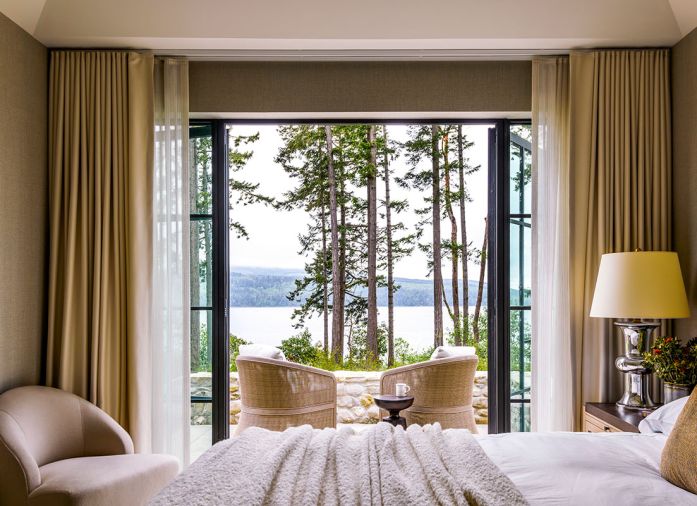
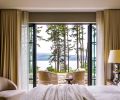
For the layout, Jennifer wanted the plan to accommodate herself and one other guest, “like a boutique hotel,” says Smith. To that end, there are two bedroom en-suites, which are separated for privacy by the main entry hall and the primary living spaces. Each suite has its own outdoor patio and outlook, with the guest room looking into the woods and Jennifer’s room taking in the water, ensuring the small home lives much larger than its square-footage.
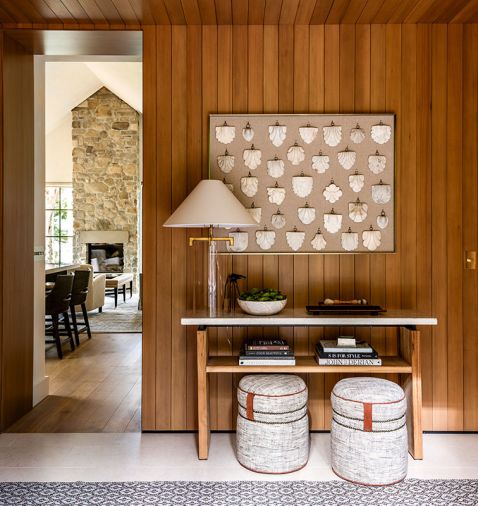
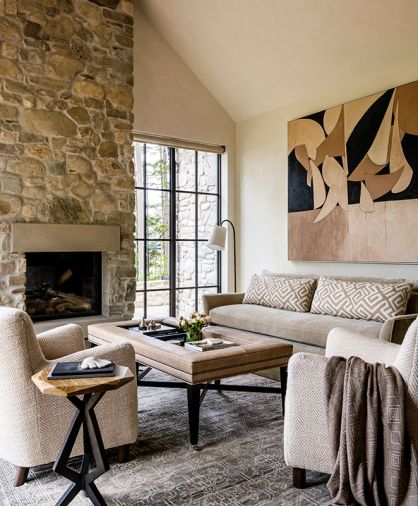
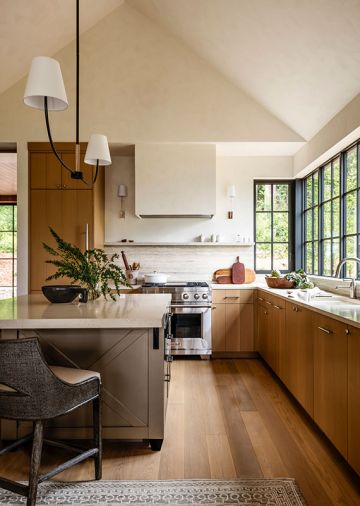
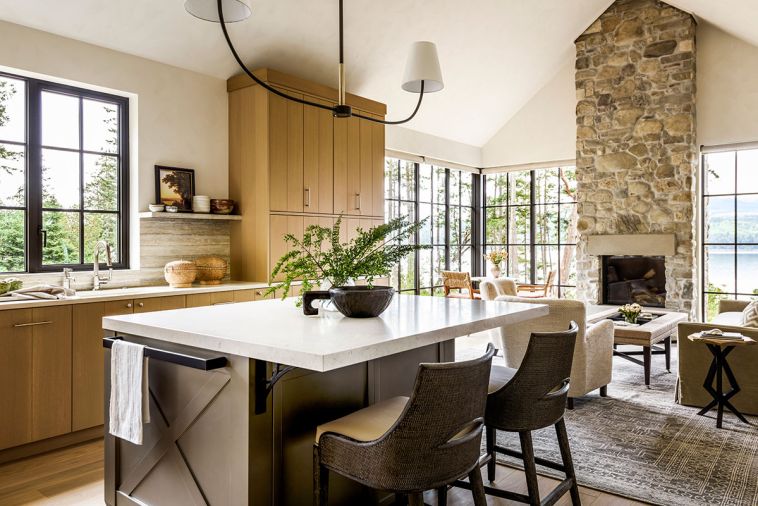
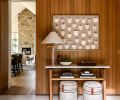
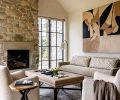
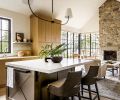
The rest of the interior palette evolved from the reclaimed stone, which also comes inside to wrap the fireplace. “Once the stone was resolved, it set the emotional and material direction for the rest of the home,” says interior designer Whitney Maehara, who worked alongside James Fung, both of NB Design. “Its sense of weight and history informed the finishes palette, the cabinetry detailing, and even the balance between light and shadow throughout the spaces.” The natural variation in the materials, from the sweep of lime wash paint on the walls, to the entry hall enveloped in tongue-and-groove hemlock, further create “a sense of depth and age, as if they’ve always belonged there,” notes Maehara.
For her part, Jennifer finds herself appreciating all the little details of the home, from the solidity of a door handle in hand, to the way a drawer closes, or the sight of the aluminum windows against the rugged stone of the fireplace. “That creates a transition that I get distracted by because I love it so much,” she says, recalling how it was inspired by a visit to Barcelona years ago when she admired ancient Roman walls brushing up against modern steel and glass interventions. “I appreciate the many ways that quality manifests in construction,” says Jennifer, and to her delight, she found that her entire team excelled at this. “They really had an eye for quality, the ability to create the details, and to demonstrate the thought that goes into the work.”
Since the architect, interior design team, and contractor have completed so many projects together over the years, quality is second-nature to them. “We have a long track record together,” says Farrel. “There’s a shorthand that we have that makes it efficient for the client.” Fung observed the same thing. “What was great about this project is that the full design team has had the opportunity to work together before on several occasions,” says Fung. “This was a benefit because we were all familiar with each other’s processes and design language, so it gave us a shorthand to problem solve and move the design forward effectively.”
Now that the cottage is complete, Jennifer has found it to be a true retreat, whether she’s curled up on the couch with a book, working in her favorite corner by the fireplace and window, or going for long walks in the woods or on the beach, checking tidepools and scrambling crabs, looking for things that she “doesn’t always notice or pay attention to,” she says. And while being back in the area has felt like “a full circle experience,” she says, it’s one that evokes the past while embracing the future. “I’m working with the landscape designers to put in a greenhouse and a fire pit, and we put in trails,” says Jennifer. “It’s become a playground for creativity.”
PROJECT SOURCES
ARCHITECT
DeForest Architects
deforestarchitects.com
INTERIOR DESIGN
NB Design Group
nbdesigngroup.net
CONTRACTOR
Lockhart Suver
lockhartsuver.com
WOOD FLOORING
Montello Design
montellodesign.co